Sign in to Loot Audio
Access your downloads, purchases and more
Access your downloads, purchases and more

Pulse is a revolutionary new downloader offering blazing fast speeds and powerful control over your libraries. Loot Audio uses Pulse to power some of our downloads and to make managing your libraries more efficient for you.
After your purchase we will send you a unique code (you will also find the code in your account). Use the code with Pulse to power your download and installation. More information about Pulse can be found here.
What are Credits?
You earn Credits every time you purchase a product from Loot Audio. 3% of your order is added to your account in the form of Credits.
Use Credits for money off future orders or convert them to Sample Credits to download samples from the Sounds section of the site.
Sleek, Streamlined, Supercharged

$161.00
Earn 417







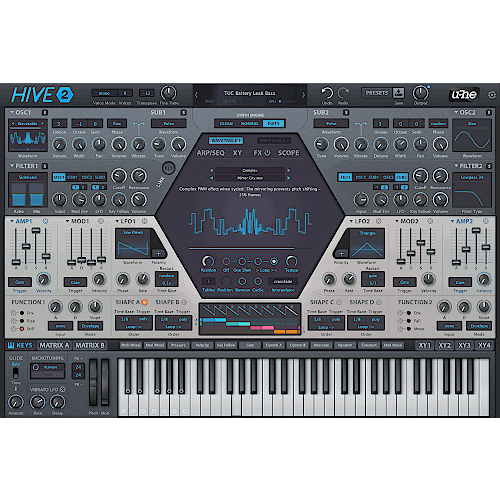
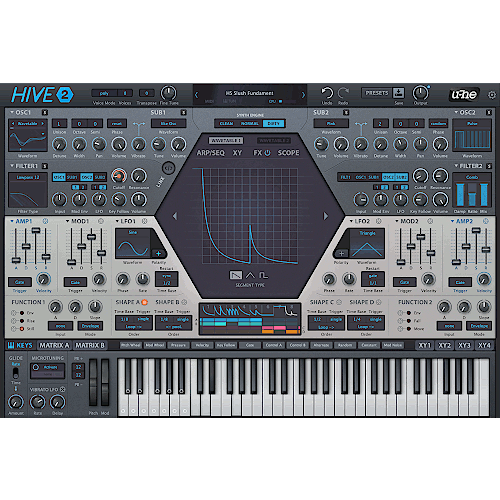
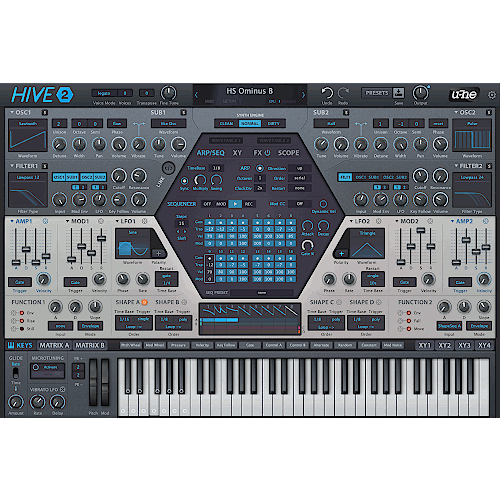
Hive 2 includes Wavetables! These appear as multiple waveforms, and are controlled in the central hexagon. You can manually select wavetables, modulate the wave position via the matrix, or even scan through them automatically using the envelope and loop options (which let you animate wavetables without the need for an extra modulation source).
This panel also offers a Reverse option to flip the wavetable back to front, Cyclic mode for seamless wavetable cycling, and various real-time interpolation methods.
MULTI-TABLE
Wavetables can be split into multiple parts (up to 16), effectively creating a 2-dimensional oscillator. For instance, a wavetable with 30 frames can be split into 3 x 10 frames by setting Tables to 3. The lower Position knob will crossfade between those 3. This feature opens up a second dimension of wavetable scanning, such as velocity crossfade or multisample support.
INTERPOLATION
Hive provides 4 different algorithms for interpolating between wavetable frames: switch, crossfade, spectral, or zero phase. The appearance (and CPU usage) of waveforms can differ significantly, depending on the chosen interpolation. The spectral and zero phase modes shift the relative phases of partials differently, while the switch option only shows non-interpolated waveforms.
The Shape Sequencer is where you can create complex modulations and/or rhythmic patterns, it offers a comfortable way to 'gamify' rhythm creation. The shape sequencer has four Shape Modulator lanes (A, B, C and D), each with an independent set of options determining how the active cells in that lane are sequenced: This means that the shape modulators can be triggered differently and run at different speeds! While it may look like a baby version of what other synths have to offer, Hive's shape sequencer can do a lot more than first meets the eye…
FUNCTION GENERATORS
Hive’s Function Generators combine simple envelope functionality with LFO, slew limiter (a.k.a. envelope follower) and gate control. Each of the three outputs has its own ‘crosshair’ you can drag & drop onto any modulation target, onto the Scope or even onto the modulation matrix source fields. Triggered and/or modulated by the LFOs, the Shape Sequencer and each other, Hive’s Function Generators can create some truly mind-bending motion effects!
The ARP/SEQ panel in the central hexagon is where you make rhythmic and melodic loops.
Arpeggiator: You can select up to 3 octaves range, 6 different direction options, and 4 for the order. Additional features are Restart, which sets the number of notes the arpeggiator will play before jumping back to the beginning, and ClockDiv, which slows the arpeggiator down relative to the sequencer.
Sequencer: The sequencer has 2 different modes, one of which lets you send control signals (CC) without triggering any notes. Like the arpeggiator, the sequence will run whenever one or more notes are played, and will stop when all notes are released. In record (REC) mode you can enter individual notes on your keyboard or even capture the output of the arpeggiator.
FLEXIBLE EFFECTS
Hive's hexagon includes 7 different effects: Distortion, Reverb, Equalizer, Chorus, Delay, Compressor, and Phaser.
Enable and rearrange: The on/off status and position of each effect in the chain is controlled using the central column: Click once to enable or disable an effect, and drag up and down to rearrange. This ease of use invites experimental combinations e.g. short reverb into highly resonant phaser into heavy distortion.
Edit and modulate: Effects in Hive are fully-featured with many editable controls, a selection of presets, and the well known u-he quality. Want more? Every control you see can be modulated in the modulation matrix – even a few you can't see.
Hive features a 12-unit modulation matrix (6 units per page) which lets you connect modulation sources (LFOs, envelopes, shape sequencer, MIDI controls etc.) to countless targets, optionally via a second modulation source. 2 targets can be assigned per unit, each with its own modulatable depth control. The row of 5 modifiers per target can alter the curvature, rectify, quantize, sample/hold or slew-limit the modulation signal: This is seriously deep stuff, but it doesn't get in the way!
PERFORMANCE CONTROLS
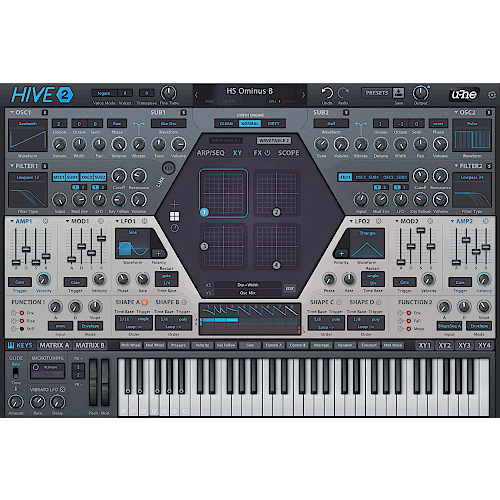
On this page you'll find a pad with 4 controls – simply connect them to your MIDI controllers for maximum fun on stage. Other views are also available.
Automatic parameter scanning: Hive is able to assign XY controls to parameters automatically. It looks into the structure of presets that have unused XY controls, and assigns them to the most appropriate XY macros (pre-defined sets of parameters). Of course you can create your own XY control definitions, with up to 4 targets per dimension.
SCOPE
Animated graphics in software synthesizers not only look cool, but can also help you program your sounds by showing you what’s happening in real time. Hive’s Scope is especially useful for displaying how the parts of complex modulation interact (e.g. the Function Generators with an LFO).
Mac OS X 10.9 or newer
Windows 7 or newer
Linux: glibc version 2.28 or newer
Host Software/DAW required
MacOS: AUv2, VST2, VST3 64-bit only
Windows: VST2, VST3, AAX 32/64-bit
1GB RAM (more recommended)
50MB free disk space
1000x600 or larger display
Windows/Linux CPU: Intel Nehalem, AMD Bulldozer or newer
Mac CPU: Intel Nehalem or newer, Apple M1