Sign in to Loot Audio
Access your downloads, purchases and more
Access your downloads, purchases and more

Pulse is a revolutionary new downloader offering blazing fast speeds and powerful control over your libraries. Loot Audio uses Pulse to power some of our downloads and to make managing your libraries more efficient for you.
After your purchase we will send you a unique code (you will also find the code in your account). Use the code with Pulse to power your download and installation. More information about Pulse can be found here.
What are Credits?
You earn Credits every time you purchase a product from Loot Audio. 3% of your order is added to your account in the form of Credits.
Use Credits for money off future orders or convert them to Sample Credits to download samples from the Sounds section of the site.
Gateway into Modular
$68.00
Earn 177







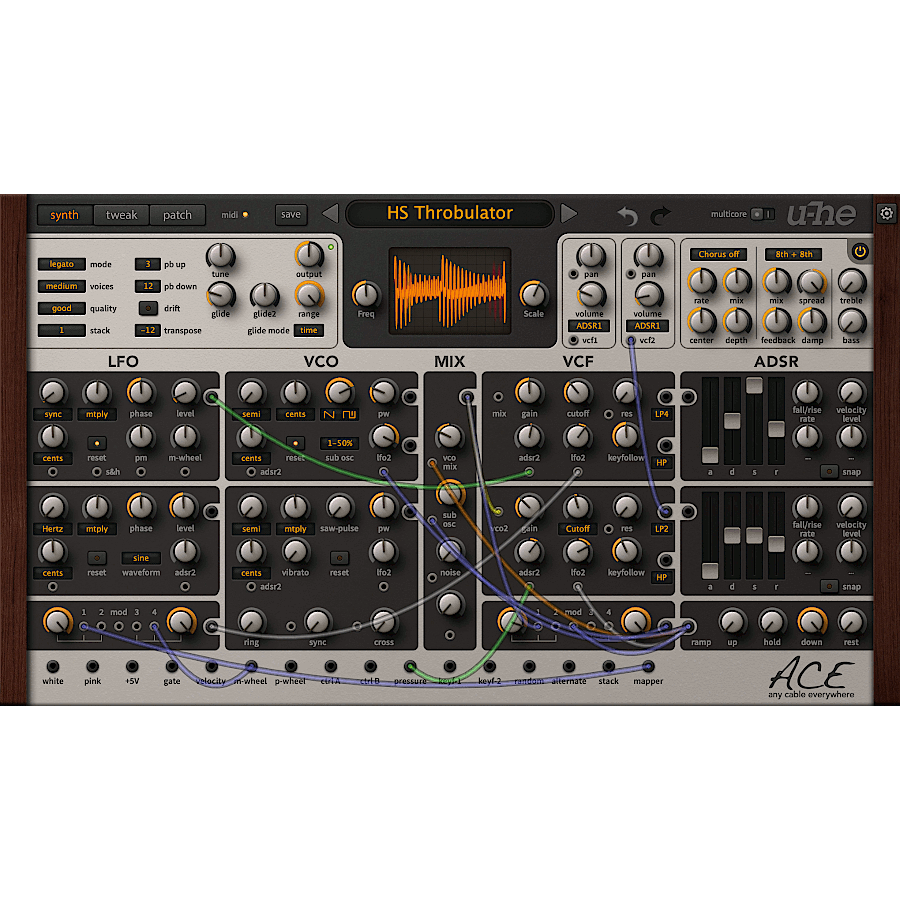
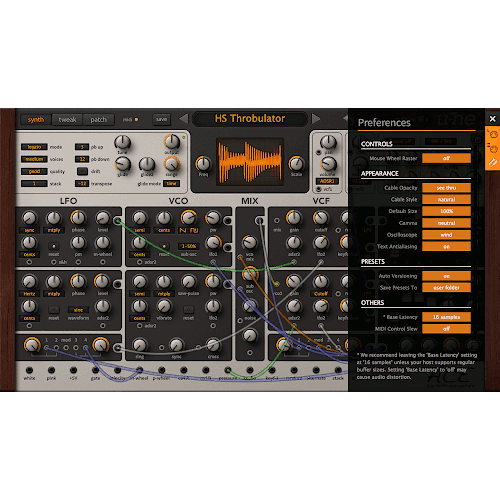
ACE takes after hardware modular synthesizers, although it is not a truly modular design, more correctly it is semi-modular. ACE has a default fixed architecture (like for instance the ARP 2600), which means you can start making noise immediately ‘out-of-the-box’. Any default routing can be overridden by patching cables, which means that the options are practically limitless.
ACE does not differentiate between audio signals and control signals. Any of the outputs can be plugged into any of the signal inputs. Hook things up, explore new ideas and crazy combinations. Try LFOs as audio oscillators or a VCO as LFO. Plug an LFO into a filter, then use the filter as an FM source for an oscillator. Sound experimentation awaits, limited only by your imagination… and dinner time.
Signal sources: An array of output sockets provide signals from a variety of different sources: noise, MIDI controls (modwheel, velocity etc.), mapping generator and more… Use these to add organic life-like dynamics, modulation and refinments your sounds.
Effects: Add final touches using the global effects. Pick from a classic stereo chorus with four modes (including phaser) to add richness, a stereo delay with seven immediately selectable modes to add movement, and finally a pair of controls to boost treble and bass.
Ramp generator: If the two ADSRs and two LFOs are not enough, try the host-syncable Ramp Generator (essentially a trapezoid, which combines elements of both).
Multiples: Common to most modular setups, multiples are mix/split devices. Signals are merged and sent onward, or split and sent to different inputs. In ACE the multiples do act as a simple mixer, or can be enlisted for much more interesting possibilities. That is why we renamed them Multiplex. Using the modulation input and some clever cable arrangements, the Multiplex modules can do ring modulation (RM), amplitude modulation (AM) or both at the same time. Or crossfading or inversion…
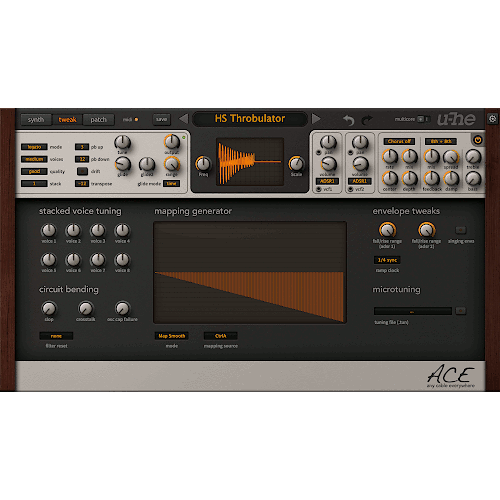
Envelopes: Without envelopes, your patches would just turn on and off with each note, organ style. Envelopes add dynamics over the length of the note. ACE has classic ADSR envelopes, but with a few extras directly available for more interesting results: Snap, fall/rise, level modulation, rate modulation, velocity. The envelopes can be further with modified in the Envelope Tweaks section. Switch on the singing envelopes for classic analogue retriggering behaviour, or adjust the fall/rise limits.
The two VCOs act as the main sound generators, but as ACE does not differentiate between audio and control (modulation) signals, the full-range LFOs can also be used to generate audio frequencies.
ACE’s oscillators are modelled on analogue circuits, including instabilities and various non-linear characteristics. You can push these characteristics further using the Circuit Bending options.
If the bottom end needs beefing up, try adding the sub-oscillator. For more intense, complex sounds, try VCO2’s ring modulation, sync and cross modulation.
The LFOs can be co-opted for sound generation. They are similar to the VCOs but have a different feature set, including the possibility of phase modulation (commonly referred to as FM synthesis) and custom waveforms (LFO2 only). Wild experimentation is welcome here—draw any waveform or use the Spectralize function to create additive waves.
MAPPING GENERATOR
Not typically found in analogue synthesizers, ACE’s Mapping Generator is a useful addition with a variety of uses. The Mapping Generator is a list of up to 128 values. You can use the drawing tools to edit the values and create your own patterns, or choose pre-built shapes. This map can be stepped through for each played note, it can create per-note offsets, it can transform any modulation source or be used as the LFO2 waveform.
FILTER
Like the oscillators, the two filters are modelled on analogue hardware and deliver satisfyingly analogue results. You can overdrive the filters without introducing any harsh distortion, and the resonance remains intact. Or you can take advantage of the self-oscillation feature for chaotic timbres and more experimental sound design.
For an extra aggressive sound, route your signal through both filters and crank the resonance on the second filter. Both filters are cascade type multimode circuits with two parallel outputs each.
Mac OS X 10.9 or newer
Windows 7 or newer
Linux: glibc version 2.28 or newer
Host Software/DAW required
MacOS: AUv2, VST2, VST3 64-bit only
Windows: VST2, VST3, AAX 32/64-bit
1GB RAM (more recommended)
50MB free disk space
1000x600 or larger display
Windows/Linux CPU: Intel Nehalem, AMD Bulldozer or newer
Mac CPU: Intel Nehalem or newer, Apple M1