Sign in to Loot Audio
Access your downloads, purchases and more
Access your downloads, purchases and more

Pulse is a revolutionary new downloader offering blazing fast speeds and powerful control over your libraries. Loot Audio uses Pulse to power some of our downloads and to make managing your libraries more efficient for you.
After your purchase we will send you a unique code (you will also find the code in your account). Use the code with Pulse to power your download and installation. More information about Pulse can be found here.
What are Credits?
You earn Credits every time you purchase a product from Loot Audio. 3% of your order is added to your account in the form of Credits.
Use Credits for money off future orders or convert them to Sample Credits to download samples from the Sounds section of the site.
Tube Graphic Equalizer
$19.90
$199.00
Earn 54







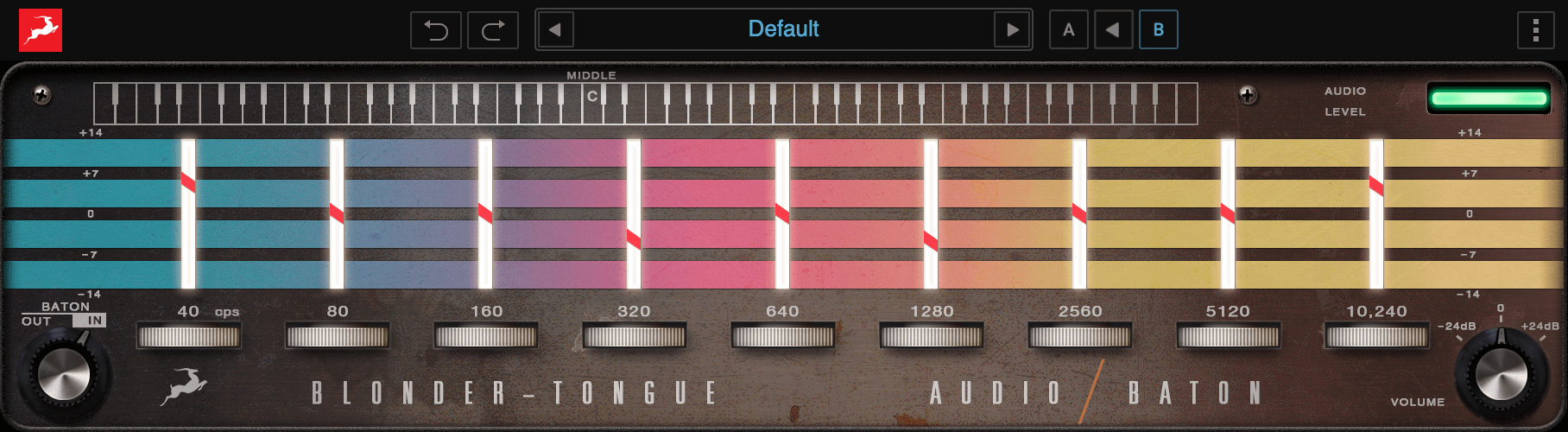
The sound of Blonder Tongue Audio Baton favorably compares to that of the other great equalizers of the era. Think of a cross between the rare Altec 9073A “Motown” graphic equalizer and the famed Pultec tube-amplified make-up gain stage.
The unit boasts seven separate amplifiers tuned to distinct frequencies, followed by high- and low-pass filters running in parallel, with their outputs routed to separate level controls. The chosen frequencies correspond to the actual notes and octaves on the piano keyboard, hence its presence above the red-and-white vertical stripes. They move up and down with the turning of the rotary controls, with boosts and cuts being conveniently visualized. This way, a frequency response curve is graphically overlaid on top of the colorful stripes where each frequency region is distinctly colored.
The Antelope Audio rendition of this collector’s item preserved its unique character and added only slight workflow enhancement – a Magic Eye peak meter on the upper right corner of the plugin which fits both this unique EQ's late 50s aesthetic and functionality by providing useful visual feedback.
Launched in 1959, despite its technical proficiency, the Audio Baton was an inexpensive unit that found its way into both recording studios and audiophile setups. In their February 1959 issue, AUDIO magazine called it ‘indispensable to anyone interested in dubbing from old records’ and ‘strongly recommended to anyone who does much recording.’ Also noted by the magazine – ‘Rolloff of either lows or highs due to poor microphones or narrow-range amplifiers or recorders can be corrected easily, and response peaks can be smoothed out as desired.’
Mac:
Windows:
Additional: