Sign in to Loot Audio
Access your downloads, purchases and more
Access your downloads, purchases and more

Pulse is a revolutionary new downloader offering blazing fast speeds and powerful control over your libraries. Loot Audio uses Pulse to power some of our downloads and to make managing your libraries more efficient for you.
After your purchase we will send you a unique code (you will also find the code in your account). Use the code with Pulse to power your download and installation. More information about Pulse can be found here.
What are Credits?
You earn Credits every time you purchase a product from Loot Audio. 3% of your order is added to your account in the form of Credits.
Use Credits for money off future orders or convert them to Sample Credits to download samples from the Sounds section of the site.
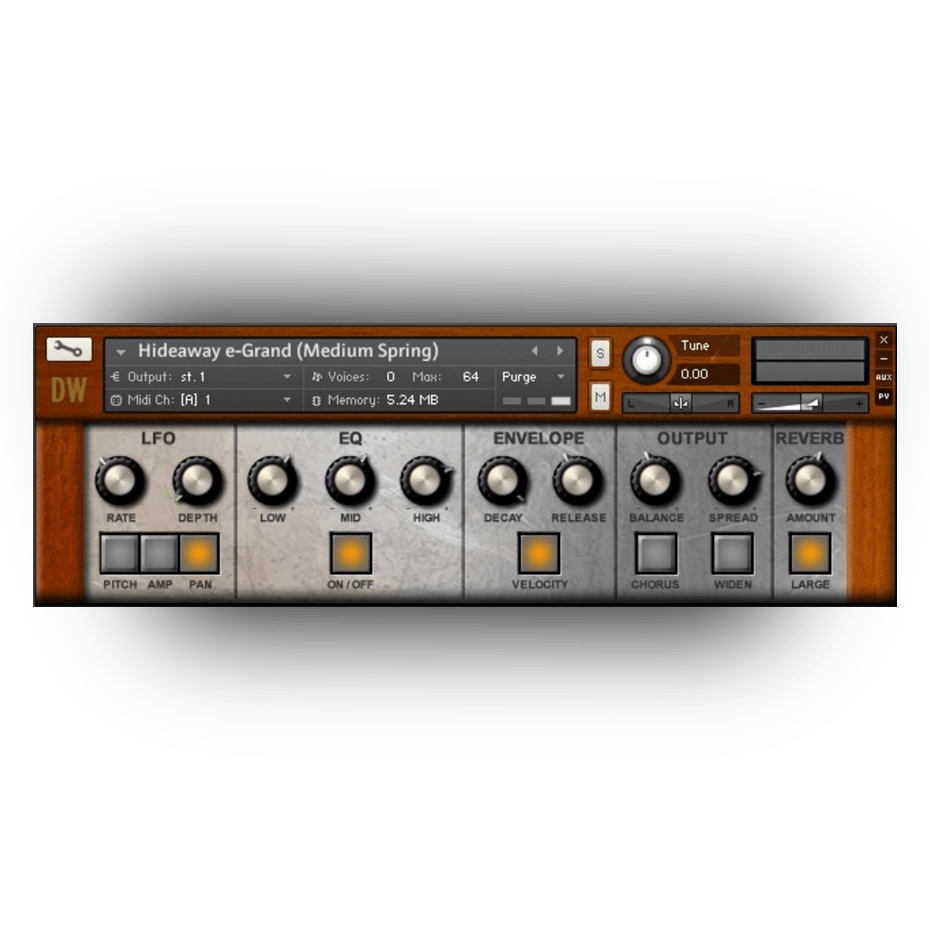
Polysynth Piano

$12.00
Earn 27
The purchase of this product includes 1946 Deagan Electric Chimes for free!
Note: This product is compatible with Kontakt Full 4.2.4 and above







If you think I ever overstate this then look up his patents from the era – one of which is pretty much the definition of the basis of the modern analog synthesizer. All have one thing in common in that they rely on formant synthesis to produce these tones. As is often the case, such instruments tend to exhibit sweet spots over relatively narrow registers.
For a while now I thought it might be interesting to try and carefully blend the best of these registers captured from the three instruments in an attempt to try and create something where an evocative, expressive and playable nature was more the end goal than realism.
As it turned out the grainy organic nature of Hideaway’s very own and rather infamously “vintage calibrated” Novachord #346 provided a special ingredient in the lower registers, the Polymoog added much of the mid-range warmth and the really quite beautiful highs were thanks to the Syntorchestra with the help of the Omega 8. After much play testing the samples were carefully layered and tube equalised.
After bringing together such a rare combination of instruments I thought it might be quite fitting to introduce some equally unusual signal processing technology. I recently rescued a 1960’s Baldwin all tube “Panoramic” stereo spring reverb. After building a high voltage power supply and modifying the spring to be centrally excited with a piezo ceramic transducer a pseudo stereo signal could be picked up from the two ends. What is particularly unusual about Baldwin’s patented design is that the signal is AM modulated at 20KHz and passed over the spring as an ultrasonic wave. The signal at the end of the spring is then received and demodulated back to audio.
The advantage of this technology is that the spring, rather bizarrely, is nothing like as sensitive to vibration as a normal spring reverb tank. It is also much less prone to the usual ricochet effects caused by high energy transients. The frequency response is a little flatter too. Although I found the reverb was a little noisy, it sounded surprisingly dense and complex so I created a series of impulse responses and was very excited to hear they worked remarkably well as a convolution reverb.
Almost by luck it turned out that the reverb worked nicely not only on vocals but also with piano. In Kontakt some careful velocity to filter and attack mapping was applied along with sustain damper emulation. All in all, an unusual combination of instruments resulting in a nique electronic piano with quite a lot of heart.
Please note this instrument ideally requires the use of a sustain pedal.
D.A.Wilson Synth Restoration Equipment & Sound Design
Stephen Howell (Hollow Sun, RIP) Conceptual GUI Design & Graphics
Mario Krušelj GUI Script
5.0/5.0
(Average of 5 reviews)
Sort By: