Sign in to Loot Audio
Access your downloads, purchases and more
Access your downloads, purchases and more

Pulse is a revolutionary new downloader offering blazing fast speeds and powerful control over your libraries. Loot Audio uses Pulse to power some of our downloads and to make managing your libraries more efficient for you.
After your purchase we will send you a unique code (you will also find the code in your account). Use the code with Pulse to power your download and installation. More information about Pulse can be found here.
What are Credits?
You earn Credits every time you purchase a product from Loot Audio. 3% of your order is added to your account in the form of Credits.
Use Credits for money off future orders or convert them to Sample Credits to download samples from the Sounds section of the site.
1983 Rhodes Chroma

$32.00
Earn 75
Bundle: Vintage Voices Bundle
Note: This product is compatible with Kontakt Full 4.2.4 and above







Philip Dodds was left to head a company dying before his eyes and several months of development were lost to company politics. The situation became dire and he was eventually left with little option but to close down the R&D department. Despite the ongoing stress of the situation he succeeded in selling on the IP rights to the Chroma design to CBS Musical Instruments and in the process was hired to oversee its production. If it wasn’t for this last gasp for survival the Chroma would surely never have existed.
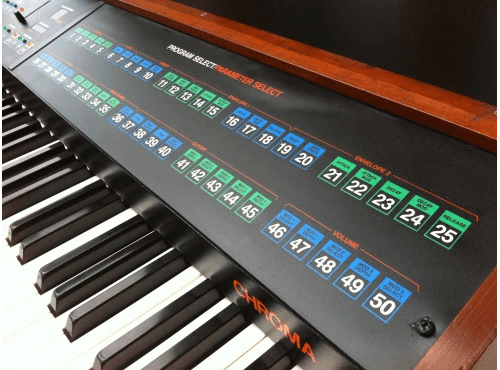
The Chroma was an advanced digitally managed 16 VCO analog synthesizer released after the initial success of the Sequential Prophet-5. Both instruments offered patch memory with the Chroma sporting a bank of 50 user programmable patches. It was one of the first analog synths to offer multi-timbral operation, voice layering and keyboard splitting with velocity sensitivity. The voice architecture was unusually flexible whereby the firmware could route signals through two low pass filters, in parallel or series, or switch the VCA before or after the filters. Through a bespoke digital interface (Chroma pre-dated MIDI) it was even possible to edit voices in a program on the Apple II computer.
CBS released the Chroma in 1981 with a list price of $5295 and proved to be pretty successful with estimates of around 1400 units eventually sold.
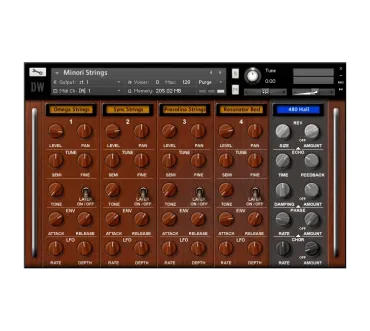
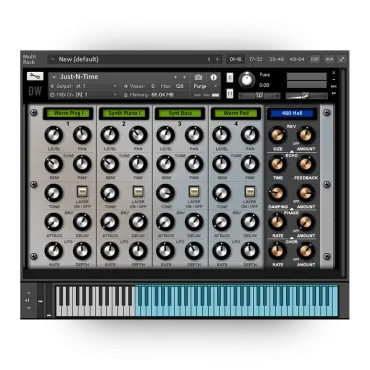
Chromatix features a deceptively powerful layering engine which allows the user to create new sounds and textures with ease by selecting up to four out of a bank of 56 partial voices to be layered. Each layer has its own fine and course tuning, ADSR envelope, panning, velocity sensitivity, LFO and tone controls. This permits anything from huge pads to complex evolving sounds. Many of the demo instrument patches included are good pointers as to how some of these effects are achieved.
Above of each of the four voice panels there is an orange LCD display showing the selected voice. By clicking on each of the displays a pull down menu appears allowing one of 56 voice partials to be selected. With a potentially vast number of layered permutations at hand two different banks of 28 partials are available the first set assigned to channels 1 & 3 and the second bank of 28 partials assigned to channels 2 & 4.
ARP Instruments, the hugely influential name behind a string of famous instruments such as the ARP2500, ARP2600, Odyssey, Avatar, Omni, Quadra and Axxe, was in its prime during the 70s but by the early 80s the tables had turned for the worse and the company was losing money hand over fist thanks to a series of unfortunate business decisions, excessive cost of sales figures and overheads.
Work had started on the Chroma in the autumn of 1979. After two years of intense development interspersed by the project being temporarily shelved on a number of occasions things were looking decidedly shaky at ARP on the financial front. This was no fault of the R&D team behind this technically challenging design but due to increasing resistance from management who had their own battles to fight.
System Requirements:
Download Contents:
Credits:
Dan Wilson (Hideaway Studio) Rhodes Chroma Restoration & Sound Design, Sample Capture, Example Patches & Demo. Stephen Howell (Hollow Sun, RIP) Original Layering Engine Concept. Mario Krušelj Synth Engine Script,GUI Design & Graphics & Anders Hedström (Flavours of Lime) GUI Graphic Design.
Naturally the example instruments packed with the library can be used as is but where the fun starts is having a go dialing in your own sounds using the intuitive layering engine. All of your creations can be saved as .nki instruments simply by using the save as function by clicking on the files icon in the main Kontakt control pane.
The layering engine consists of four identical programming panels and an effects section. This release is the first to use a recently updated version of the layering engine which has recently been revised to include separate velocity sensitivity controls for each layer.
The TONE control is a deceptively powerful feature. In the fully downward position the signal is unaffected. As the control is moved upwards a continuously evolving complex EQ curve is applied. With some experimentation this feature can be used for embellishing formants within each voice partial and helping to sit each of the layers together in the mix.
4.5/5.0
(Average of 13 reviews)
Sort By: