Sign in to Loot Audio
Access your downloads, purchases and more
Access your downloads, purchases and more

Pulse is a revolutionary new downloader offering blazing fast speeds and powerful control over your libraries. Loot Audio uses Pulse to power some of our downloads and to make managing your libraries more efficient for you.
After your purchase we will send you a unique code (you will also find the code in your account). Use the code with Pulse to power your download and installation. More information about Pulse can be found here.
What are Credits?
You earn Credits every time you purchase a product from Loot Audio. 3% of your order is added to your account in the form of Credits.
Use Credits for money off future orders or convert them to Sample Credits to download samples from the Sounds section of the site.
Welcome to the 1980s

$24.00
Earn 57
Note: This product is compatible with Kontakt Full 4.2.4 and above







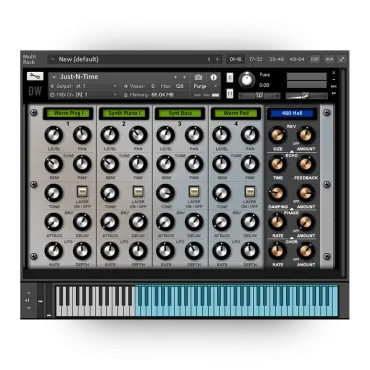
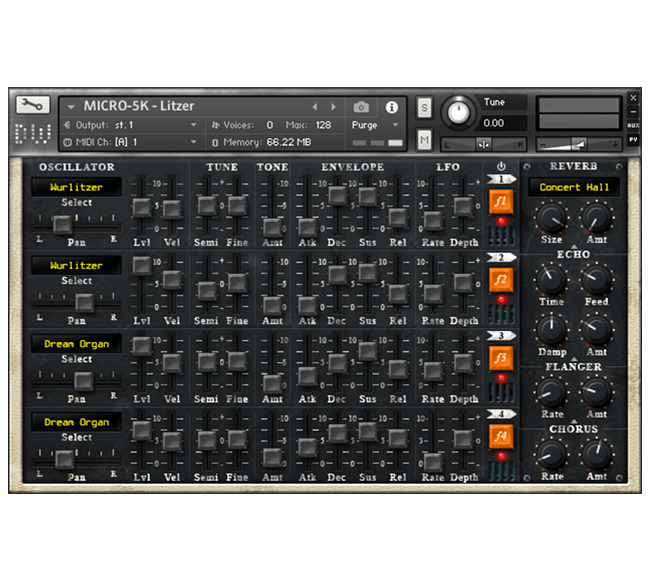
In a market largely dominated by analog synthesizers the MUSIC 5000 was in many ways not just affordable but actually rather ahead of its time. Originally designed by Chris Jordan it was somewhat close to being an inexpensive variant of Hal Alles’ proposed “Digital High Speed Oscillator System”. Detailed by Alles in 1979 in a paper called “An Inexpensive Digital Sound Synthesizer”, it originally formed the basis of the huge Bell Labs “Alles Machine”, the eye-wateringly expensive 1979 Crumar G.D.S. and the Digital Keyboards Synergy. All of these systems used a bank of wave-tables which were played back using the digital “phase-accumulation” method. Having accurate high-speed phase control over the wave-tables allowed mathematical operations to be applied between pairs of oscillators in hardware in real-time. In the case of the MUSIC 5000 this permitted amplitude, phase and ring-modulation and osc-sync, all in the digital domain. Up to 8 stereo channels with 24-bit frequency control accuracy clocked at 47KHz could be utilised in a single sound or a number of different sounds played concurrently (multi-timbral). This was pretty impressive for an affordable digital music synthesizer module which was first released in 1983. Even more impressive is that the whole thing was implemented in a handful of stock logic and RAM chips on one pcb!
Unlike its more expensive 16-bit counterparts the MUSIC 5000 produced its output at 8-bit resolution but it used companding u-Law converters which sounded more like 12-bit audio thanks to their improved low signal level accuracy.
Obviously by today’s standards the MUSIC 5000 is very much outdated and pretty primitive but, like so many early offerings, it has a unique character all of its own.
All Controlled by a Computer Language called AMPLE?
Unusually the MUSIC 5000 low-level control method was more akin to something found in a research lab ie. all of its synthesis and music production functions were programmed at the command line in a language called AMPLE. Although there were later front ends offering basic user interfaces to make things a little more friendly, the programming language still interfaced with the hardware itself.
No MIDI Input?
Nope.. not originally – the user had to hand code his music compositions into the computer. Later a keyboard was produced… and very much later I designed a custom MIDI interface which was put to great use to produce this library!
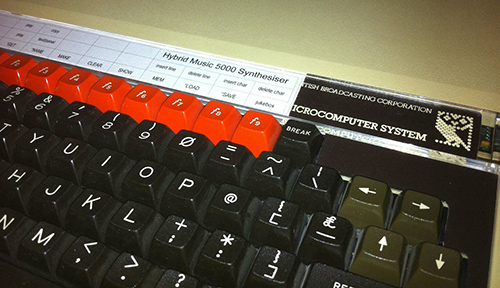
All sample material captured from a 1986 Hybrid Technology Ltd MUSIC 5000 synth module controlled by a 1983 Acorn BBC Micro Model B running the AMPLE music programming language. Sample capture in 24-bit audio using an RME Fireface fed via a 1969 Fairchild model 662 germanium pre-amp and model 664 transformer-coupled passive-EQ. MIDI control offered by Hideaway Studio’s M5KMIDI a custom MUSIC 5000 MIDI interface for the BBC Micro.
Download Contents:
Credits
D.A.Wilson (Hideaway Studio) - MUSIC5000 Installation/Overhaul, Sound Design, Sample Set & Example Instruments
Stephen Howell (Hollow Sun, RIP) - Original Quad Layering Engine Concept for Hideaway Studio
Anders Hedstrom (Flavours of Lime) - GUI Design & Graphics
Mario Krušelj - Layering Engine Script
Simon Power (MEONSOUND) - Play Testing
A very big thank you to Mark Haysman at RetroClinic for supplying the MUSIC 5000 synth module and helping me to upgrade the Acorn BBC Micro with a Gotek HxC floppy emulator.
For more information and many more releases for Kontakt by Hideaway Studio please visit: www.hideawaystudio.net
5.0/5.0
(Average of 6 reviews)
Sort By: