Sign in to Loot Audio
Access your downloads, purchases and more
Access your downloads, purchases and more

Pulse is a revolutionary new downloader offering blazing fast speeds and powerful control over your libraries. Loot Audio uses Pulse to power some of our downloads and to make managing your libraries more efficient for you.
After your purchase we will send you a unique code (you will also find the code in your account). Use the code with Pulse to power your download and installation. More information about Pulse can be found here.
What are Credits?
You earn Credits every time you purchase a product from Loot Audio. 3% of your order is added to your account in the form of Credits.
Use Credits for money off future orders or convert them to Sample Credits to download samples from the Sounds section of the site.
The polyconvolution synthesiser

$249.00
Earn 747







Producer, composer, and artist, BT has done it all — from pioneering dance tracks and scoring The Fast and the Furious, to writing & producing for Sting, Peter Gabriel and David Bowie. Together with Spitfire Audio, BT has combined over 20GB of his own personal bespoke libraries into a convolution synthesis engine that allows you to sculpt, filter, rhythmically cut and pulse impulse responses that are tonal, melodic and harmonic. Most importantly, you can play them polyphonically.
This synthesizer, sound engine and bespoke library package represents years of diligent searching for new awe-inspiring sounds and sound design techniques. If you, like BT, are looking for a new wave of inspiration for evocative, emotional, expressive and original compositions, this is the well of endless inspiration you need.
One of the greatest solutions Phobos provides is for composers wanting to engage their audiences in extended sequences and cues without things sounding repetitive or ‘loopy'. Phobos allows for an all new real-time interface interaction that allows the user to evolve, warp and transform their molecular patterns according to nuanced changes within a scene.


What is Phobos? One of Mars’ moons? A synthesizer? A tool for creating massive cinematic and electronic rhythms? An engine for endless spectral combinations of wide, lush pads and ambiences with propulsive rhythmic figures? Is it a sound library of bespoke percussion, beats, micro rhythms, field recordings, live acoustic and orchestral treatments, textures and a massive vintage synthesizer collection? That is just scratching the surface.
At its core, Phobos is a synthesizer based on the unexplored precept of polyconvolution as a synthesis engine. BT came up with this idea many years ago doing sound design. What does that mean exactly? Polyconvolution as a synthesizer? Well, it means instead of using convolution for reverb or modeling an amplifier's distortion circuit, why not make a “reverb” impulse response tonal?
Combining something rhythmic with something tonal (as an impulse response) yielded some of the most modern, liquid and percolating ambiences and textures BT had ever heard. These are the kinds of sounds he has been searching for whilst scoring; those elusive sounds where the director asks for movement and drive, both subtle and massive.
Phobos challenges the convention of loops, tones and how they are used in convolution. Which is why when clicking on the name of any of the sound sources OR any of the convolvers, you will be greeted with exactly the same browser.

The ability to automate many of the fantastic and unique controllers is central to the vision of Phobos, which is why modulation mappings - the way in which functions are mapped and then ‘modulated’ (or changed) in realtime or automated via controllers - are key to many of our presets, and are applied both to Source/Convolver.

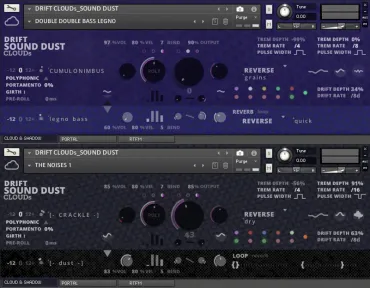
A set of controls to further adapt each Source such as ADSR, start offset, filters and gates.

A set of controls to further adapt each Convolver and its impulse response. This is very similar to the controls for the sources and provides all the same functionality for the convolvers.

Controls for the LFOs. There are four independently configurable LFOs that can be used to control your parameters by selecting them in mappings.

macOS requirements
PC requirements
File size