Sign in to Loot Audio
Access your downloads, purchases and more
Access your downloads, purchases and more

Pulse is a revolutionary new downloader offering blazing fast speeds and powerful control over your libraries. Loot Audio uses Pulse to power some of our downloads and to make managing your libraries more efficient for you.
After your purchase we will send you a unique code (you will also find the code in your account). Use the code with Pulse to power your download and installation. More information about Pulse can be found here.
What are Credits?
You earn Credits every time you purchase a product from Loot Audio. 3% of your order is added to your account in the form of Credits.
Use Credits for money off future orders or convert them to Sample Credits to download samples from the Sounds section of the site.
A meticulously crafted virtual recreation that captures the unique and captivating features of the exceptional analog monosynth from 1983.
$59.00
Earn 153







Crumar S.P.A., based in Castelfidardo, Italy, was a notable player in the 1970s musical instrument industry, specializing in home organs, digital pianos, and multi-sound keyboards, and with a significant focus on the U.S. market. Sante Crucianelli, the son of the owner, became the driving force behind Crumar's design and strategies. Crumar became known for its open lab culture, frequently allowing competitors to test instruments, a rare practice for the time. Another key figure during this period was Luciano Jura, a designer, musician, and programmer. Luciano became crucial as Crumar's point of contact with synth pioneer Bob Moog, which led to a collaboration that resulted in the creation of Crumar's Spirit synthesizer.
Although many details have been lost due to the passing of key figures and the closure of Crumar, the development of the Spirit synthesizer in the U.S. is well documented. Key contributors to the project, codenamed "Little Synth," included Moog engineer Jim Scott, Moog clinician and electronic music historian Tom Rhea, and Bob Moog himself. The project likely began around 1980 or 1981, and incorporated elements from earlier projects by Scott and Moog. Rhea played an essential role in defining the Spirit's key features, such as the keyboard scanning setup, panel layout, functional architecture, and technical documentation. The Crumar Spirit went into production and was released in late 1983.
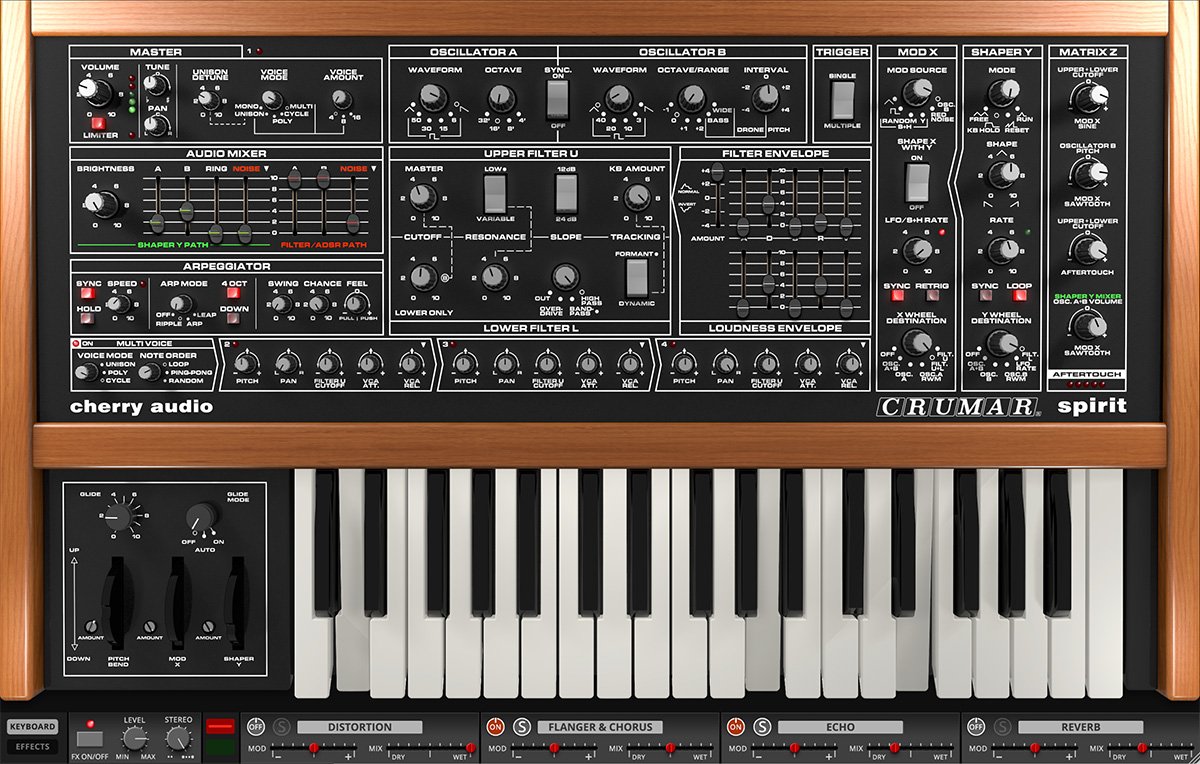
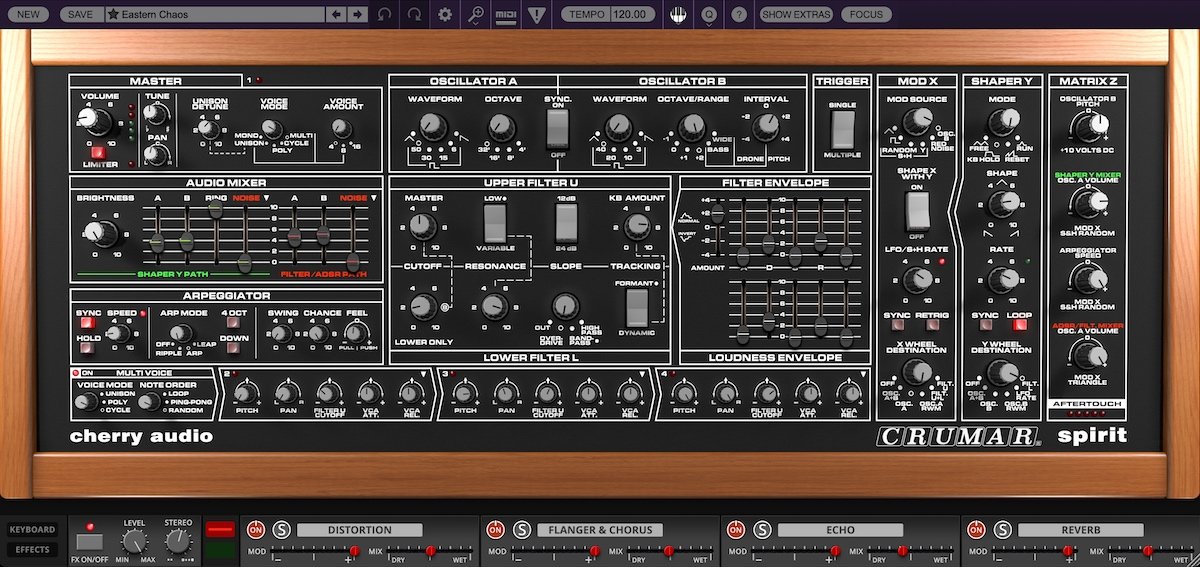
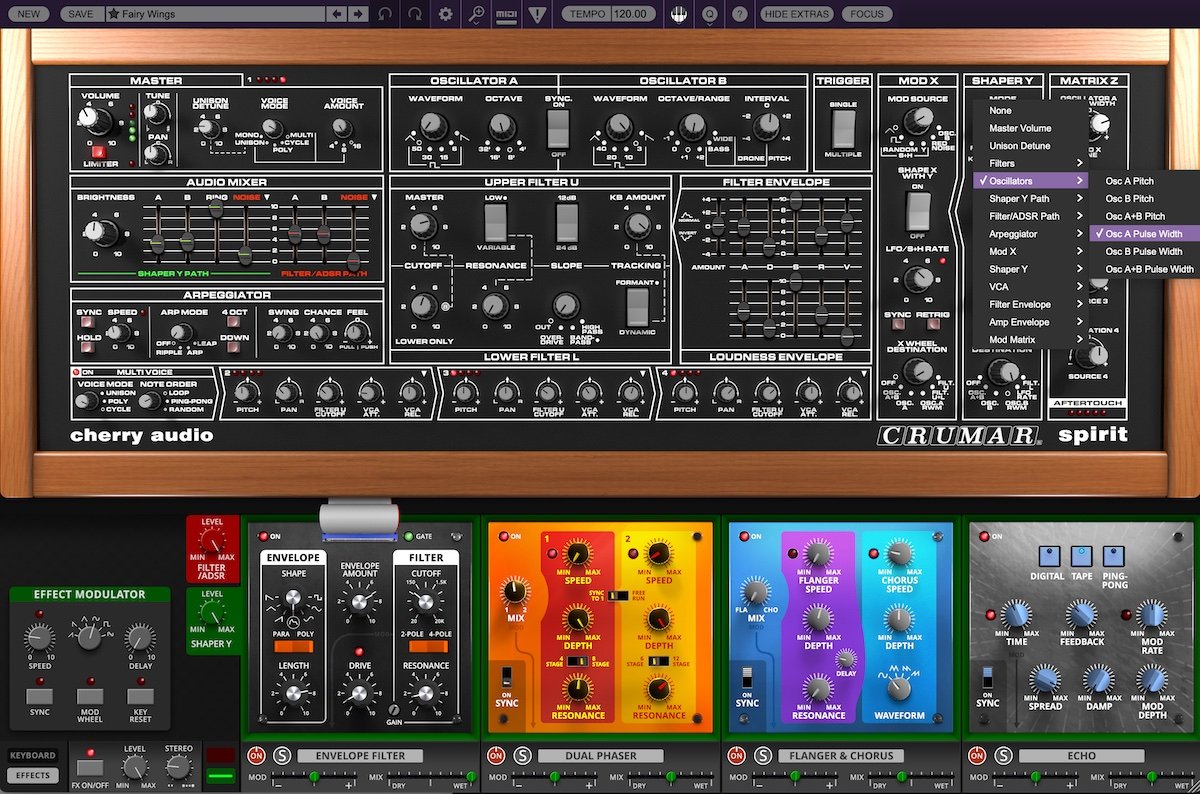
Cherry Audio's reenvisioning of the Spirit synthesizer includes all the innovations and deep sound capabilities of the original hardware while enhancing it with modern design elements tailored for today’s musicians and sound designers. We have increased its polyphony and added more voice modes, along with expanding its already extensive modulation capabilities with a new "Matrix Z" control, a mod matrix with four independent pathways.
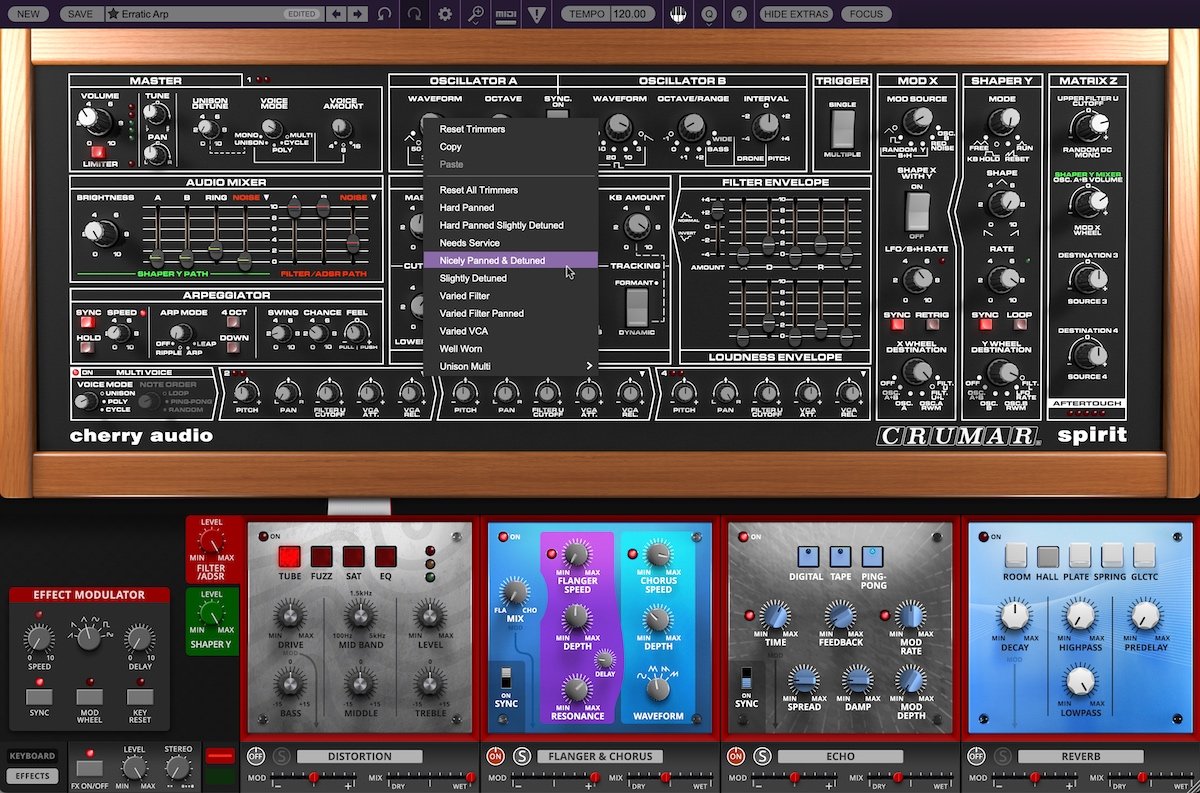
Spirit's unique arpeggiator has been replicated and enhanced with swing, chance, and feel to add degrees of randomness and a human touch to patterns. Additionally, we have integrated dual chains of studio-grade effects, made the synthesizer more expressive with velocity and aftertouch (including polyphonic aftertouch), and provided 400 presets created by six professional sound designers. All of this is presented in an easy-to-navigate interface, making this once-esoteric synth feel like an old friend.
The Spirit synthesizer, despite its surface resemblance to other analog monosynths of the period, featured several unique attributes that set it apart. Its architecture included integrated circuits also found in highly regarded synthesizers like the Rhodes Chroma, Memorymoog, various Oberheims and Prophets, PPG Waves, the Super Jupiter, and the Ensoniq ESQ1 and SQ80. The Spirit was equipped with two CEM3340 oscillators, CEM3350 Dual VCFs, and six CEM3360 Dual VCAs.
Spirit boasted two VCOs, which could be synced together. Oscillator B offered independent octave range settings relative to Oscillator A, as well as the ability to be decoupled from the keyboard's pitch CV for drone or extended range possibilities. Oscillator B could be used as a modulation source for Oscillator A.
The Spirit routed the oscillators through two distinct signal paths, one with the VCFs and VCA (referred to as the upper Filter/ADSR path) and another with a mixer that includes the ring modulator and noise generator controlled by the "Shaper-Y" LFO/EG. The Spirit's filter section featured both an upper low-pass filter and a lower filter with high-pass, band-pass, and a distinct "Overdrive" mode for adding a distinct saturated quality to the sound. It provided switchable filter slopes of either 12dB or 24dB, and an independent filter envelope enabled precise control of the filter's dynamics, separate from the ADSR envelope. Dynamic keyboard tracking is available for both filters, with a switch for a fixed formant option for the lower filter.
Its extensive modulation options were one of Spirit's standout features, featuring two LFOs, Mod-X and Shaper-Y, which provided a wide range of modulation routing possibilities. Each LFO has a dedicated mod wheel for real-time control of modulation depth, with Mod-X sources including triangle wave, square wave, Sample & Hold (S&H), Shaper Y, red noise, and Oscillator B. Shaper-Y could also work as a loopable two-stage envelope or function as a free-running LFO.
Furthermore, the Spirit included a unique arpeggiator with three patterns, including an elaborate "Leap" mode that allowed for intricate multi-octave sequences. The ring modulator added harmonic richness and metallic tones, while the external audio input feature enabled the processing of outside signals. The Spirit had two portamento modes: "On," which operated like most synths, and "Auto," which activated only when the first key was held down while playing the second.
The Crumar Spirit was a complex instrument known for its powerful features and unique design, making it a valuable tool for musicians seeking deep synthesis capabilities. However, it faced commercial difficulties, arriving on the market after Yamaha's DX7 and during a period when musical trends were shifting towards digital and full polyphony. Estimates suggest that as few as 100 or less Spirit synthesizers were manufactured. Additionally, a crisis in Italy's instrument industry further complicated its situation, and Crumar ceased operations in 1986
Crumar Spirit by Cherry Audio synthesizer is available in AU, VST, VST3, AAX, and standalone formats.
macOS Requirements: macOS Requirements: macOS 10.13 or above. 64-bit required. Intel or Apple Silicon processor. 3.4 GHz Quad-Core or Apple Silicon CPU with 8GB of RAM is recommended. Hard disk space: 64 MB.
Windows Requirements: Windows 7 or above (including Windows 11), 64-bit required. 3.4 GHz Quad-Core computer with 8GB of RAM recommended. Hard disk space: 64 MB.